
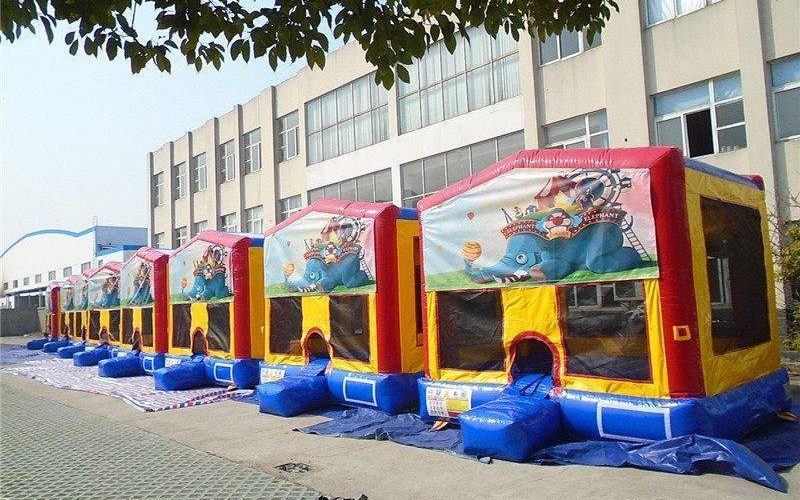
When planning an outdoor event, choosing the right jumping castle is just the first step. For professional inflatable rental operators, event organizers, and conscientious parents across Australia, the critical question is not just about the footprint of the castle itself, but how much safe buffer space is required around it.
An incorrect installation that provides insufficient clearance is a leading cause of injuries and equipment damage. In Australia, adhering to strict safety standards, specifically AS 3533.4.1, requires a defined buffer zone known as the “Impact Area.” This guide breaks down the essential space requirements, measurements, and common pitfalls for safely positioning a jumping castle.
1. Understanding the Australian “Impact Area” (Buffer Zone)
The concept of a buffer zone around an inflatable isn’t just a suggestion; it is a mandatory safety requirement designed to protect users who may fall from or tumbles out of the unit. The specific distance is dependent on the potential fall height from the inflatable’s jump platform.
General Guidelines for Clearance:
- Sides and Back: For most standard, commercial-grade jumping castles with a jump height of less than 3 metres, a minimum clearance of 1.8 metres (approx. 6 feet) is the professional standard and aligned with regulatory expectations. This area must be completely clear of obstacles.
- The Entrance/Exit: This is the highest risk area. While the sides require 1.8 metres, the area directly in front of the entry point requires at least 2 metres of clear space. This area must also be covered by soft Impact Mats for cushioned landing.
2. Common Obstacles and Risks
The buffer zone must be entirely free of any object that could injure a child or damage the inflatable’s 0.55mm PVC material. When surveying a potential site, look for:
- Fixed Structures: Fences, brick retaining walls, sheds, or garden beds. A collision with a fence at the back of a jumping castle is a high risk if the clearance is insufficient.
- Overhead Hazards: Tree branches, clotheslines, and overhead power lines. This requires checking not only the width of the buffer but also the height of the inflatable and the 1.8-metre overhead zone.
- Operational Risks: Ensure no other event activity, such as a barbecue station or other temporary stalls, is positioned within the impact area.
3. Calculating the Space for Your Event (Example)
Let’s calculate the total site area required for a typical, medium-sized jumping castle:
Castle Measurements (Footprint): 5 metres (length) x 5 metres (width).
Required Clearance:
- Sides & Rear: + 1.8m (each side)
- Front Entry: + 2.0m (front only)
Total Site Dimensions Required:
- Total Length: 5.0m + 1.8m (rear) + 2.0m (front) = 8.8 metres
- Total Width: 5.0m + 1.8m (left) + 1.8m (right) = 8.6 metres
Conclusion: A 5m x 5m jumping castle requires a minimum clear area of roughly 8.8m x 8.6m to be installed safely and meet Australian standards. Always check the height clearance as well, ensuring at least 1.8 metres of clear sky above the highest point of the inflatable.
4. Special Considerations for Hard Surfaces
If you are installing the jumping castle on a hard surface like concrete, the 2-metre impact area in front of the entry must be covered by cushioned mats. Furthermore, on a sloped surface or areas susceptible to sudden wind, the sides and rear also require impact protection, and the buffer area should be slightly wider to accommodate potential sliding or tipping.
Summary Checklist for a Safe Impact Area
- Measurement: Verify you have a minimum 1.8m clearance on all non-entry sides.
- Orientation: Position the main entry so that it has 2m of clear space.
- Overhead: Confirm no branches or power lines are within 1.8m of the maximum inflated height.
- Mats: Place high-density impact mats at the designated entrance/exit zones.
- AS Compliance: Consult the inflatable’s logbook or AS 3533.4.1 for any specific impact area measurements dictated by the fall height of that specific model.
Conclusion
Providing sufficient space around a jumping castle is not optional; it is a fundamental pillar of risk management. By respecting the minimum 1.8-metre impact zone and ensuring it remains completely free from obstructions, you protect both the participants and the integrity of your equipment. For any professional operator in Australia, safety is paramount—never compromise on space just to secure a booking.